
If I had to pick the financial planning "hack" people ask me about most, it's the backdoor Roth. (Rental real estate is a close second, but that's not a hack. That's a huge, lifestyle-altering project, and a blog post for another day.)
Some clients hear about the backdoor Roth and want to know how to do it. Others tried it, something went sideways, and they come to me to help clean it up. Either way, almost everyone gets stuck in the exact same spot: they already have money sitting in an IRA somewhere. And that's when sh*t gets complicated.
The good news? A big pre-tax IRA usually doesn't mean the door is closed. It just means we need to do things in the right order. Let's back up and start from the beginning.
First, What is the Difference Between a Roth IRA and a Traditional IRA?
The big difference between these two accounts is when you pay tax.
With a traditional IRA, you often get a tax deduction when you put money in, it grows tax-deferred, and you pay ordinary income tax when you take it out in retirement. AKA the pay tax later strategy.
With a Roth IRA, you put in money you've already paid tax on, it grows, and qualified withdrawals in retirement are completely tax-free. AKA the pay tax now strategy.
I love Roth money for a lot of my early-career clients: tax-free growth for decades, more flexibility down the road, and no required minimum distributions during your lifetime. The catch is that the IRS doesn't let everyone contribute directly.
So I Can’t Just Contribute to a Roth IRA Directly? What is a Backdoor Roth?
For 2026, your ability to contribute directly to a Roth starts phasing out at $153,000 of modified adjusted gross income if you're single and $242,000 if you're married filing jointly. Your ability to contribute at all goes away once you hit $168,000 for single filers and $252,000 for joint filers. Your Modified Adjusted Gross Income (MAGI) includes things like capital gains, interest, etc. in addition to your salary. If you're under those income limits, you don't need to do a Backdoor Roth. Just contribute to your Roth normally and go enjoy your day.
If you are over those, then a backdoor roth may be your only option to contribute to a Roth IRA. To clarify, a backdoor Roth is a process, not a type of account. There's no special "backdoor" account you open. It's a two-step workaround to get money into a Roth IRA when your income is too high to contribute directly.
Step 1: Make a nondeductible contribution to a traditional IRA. You contribute to the Traditional IRA, but you don’t take a deduction for it. By doing so, you now have after-tax money in this Traditional IRA. I recommend leaving it in cash (don't invest it yet!) so it doesn't grow before the next step.
Step 2: Convert that traditional IRA to a Roth IRA. Often a few days to a few months later. Once it's in the Roth, invest it.
Why is this (normally) close to tax-free? Because you already paid tax on the money going in. Say you contribute the 2026 max of $7,500 and convert it a couple weeks later. You've got $7,500 of after-tax money (this is your "basis") and you are now converting it into $7,500 of Roth money. Usually when you convert pre-tax funds from an IRA you have to pay taxes on it. In this case, the funds you are converting are ALREADY after-tax so there's nothing left to tax!
Okay, great. Can I do it?
Possibly? Probably? The big catch is something called the pro-rata rule.
When you convert, the IRS doesn't let you pick which dollars you're converting. You can’t JUST convert the after-tax funds. The IRS lumps all of your traditional, SEP, SIMPLE, and rollover IRAs together into one big pot, and every dollar you convert is treated as a proportional mix of the after-tax and pre-tax money in that pot. 401(k)s, Roth IRAs, and inherited IRAs aren't part of the pot. However, a surviving spouse who elects to treat an inherited IRA as their own has made it part of the pot.
If you like math, read on to see how this pro-rata rule plays out. If you don’t, skip this next part.
Say you have an old rollover IRA from a previous job:
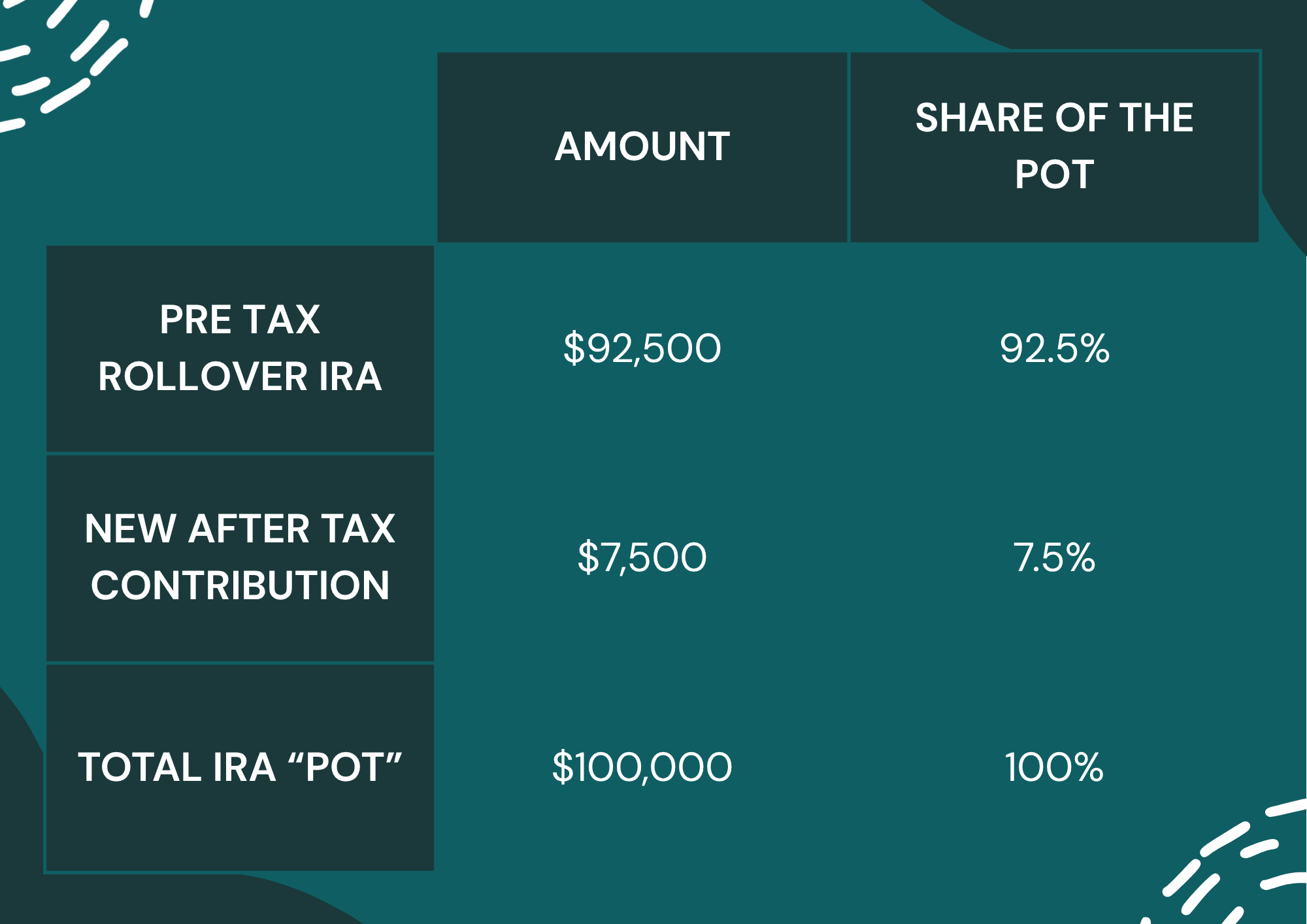
You convert your $7,500 thinking it'll be tax-free. But because only 7.5% of your pot is after-tax, only 7.5% of the conversion is tax-free. That means roughly $6,938 of your $7,500 conversion is taxable. Which kind of defeats the whole purpose of not paying taxes on it!
And it doesn't end there. The leftover basis stays in that IRA, and you (and your tax preparer) have to keep tracking it on Form 8606 potentially for 30 years. It's annoying AF and very prone to mistakes.
One detail that matters a lot for later: the pro-rata math uses your IRA balances as of December 31 of the year you convert. That's what gives us a way out.
Okay, so what is the way out? Try a reverse rollover!
A reverse rollover (sometimes called a "roll-in") just means moving pre-tax IRA money into an employer plan, like a 401(k), 403(b), or solo 401(k). Most people roll money the other direction, out of old 401(k)s and into IRAs, which is exactly how so many of us end up with big rollover IRAs in the first place.
Why does this work? Because employer plan balances aren't counted in the pro-rata calculation. Get the pre-tax money out of your IRAs and into a 401(k) before December 31, and the IRS's "one big pot" is suddenly empty.
Here's the same example, before and after:
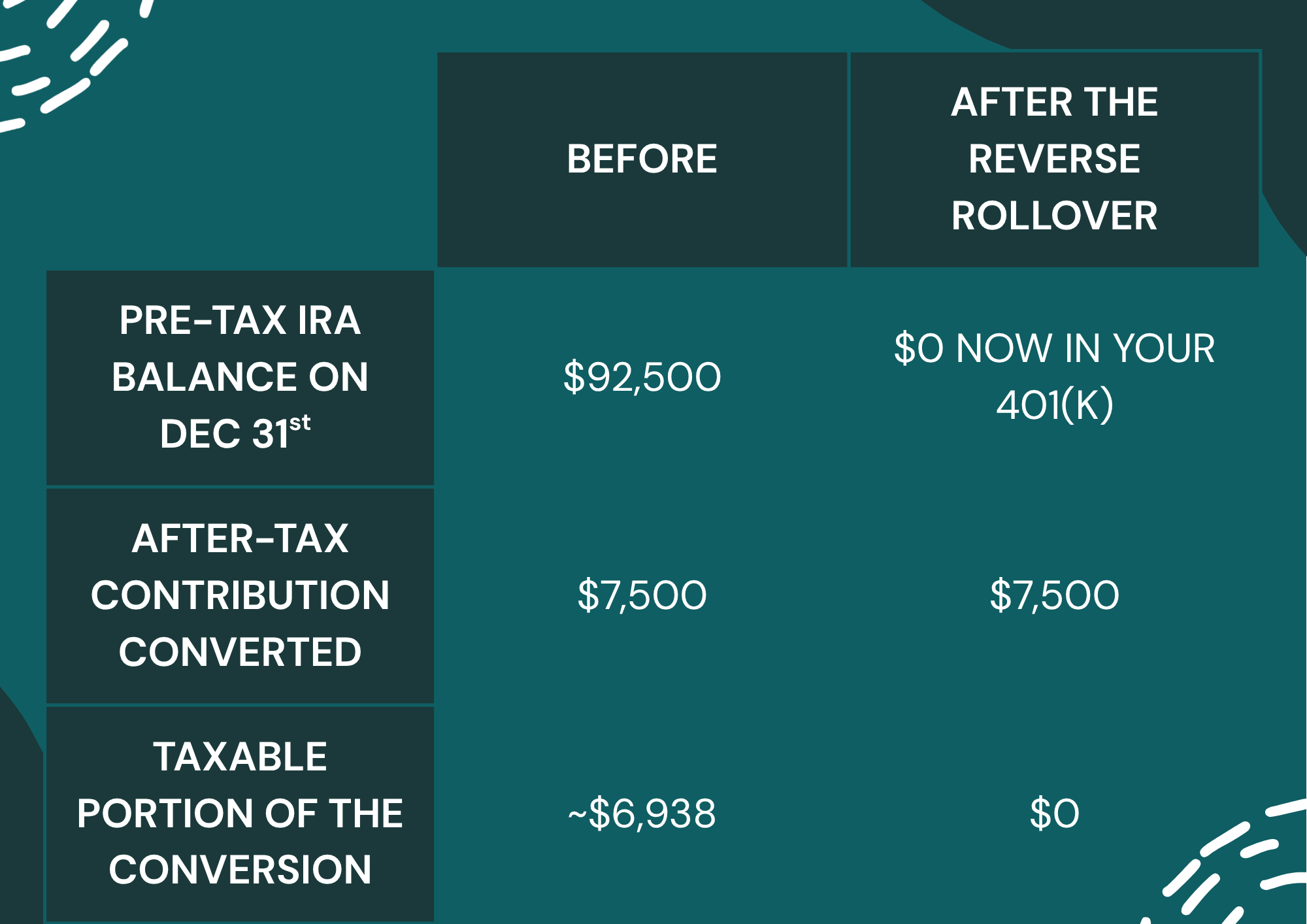
Same money, same accounts, just better sequencing.
Already have basis stuck in an old IRA? This works for you too. Only pre-tax money is allowed to roll into an employer plan, so when you roll over the pre-tax portion, your after-tax basis gets left behind on its own. That “stranded basis” can then be converted to Roth tax-free, and you're starting fresh with a clean slate for future backdoor contributions. This can get mucky, so feel free to reach out if you want to discuss this.
Fun fact for my federal-employee readers: the TSP accepts roll-ins of pre-tax IRA money even after you've separated from service, as long as you still have money in your TSP account. Once you've cashed out or rolled your TSP balance out entirely, that door closes, so think twice before moving it.
How to do it, step by step:
Confirm your employer plan accepts roll-ins. Many do, but not all. Call the plan administrator or check the plan documents.
Confirm it accepts pre-tax IRA money specifically. Some plans only take rollovers from other employer plans, not from IRAs.
Request a direct (trustee-to-trustee) rollover. The money goes straight from your IRA custodian to the plan. This avoids tax withholding and the 60-day rollover deadline entirely. This can get complicated if they mail the check to you first, in which case you then need to mail the check to your 401k plan.
Confirm every traditional, SEP, SIMPLE, and rollover IRA shows $0 before you start the backdoor. Technically, the IRS only looks at your December 31 balance. But I have my clients wait for that zero first, because if the rollover stalls or gets forgotten after you've already converted, you're stuck untangling a taxable conversion before year-end.
Then make your nondeductible traditional IRA contribution and convert it to Roth. Same two-step as above, just on a clean slate.
File Form 8606 with your tax return. This is how you tell the IRS your contribution was nondeductible and your conversion shouldn't be taxed. Your custodian does not track your basis for you, so if this form is missing, the IRS assumes the whole thing is taxable.
Who this works for (and who should think twice):
This tends to be a great fit if you:
Have a current employer plan that accepts roll-ins of IRA money.
Earn income from a job (or self-employment income in which case you may be able to open a solo 401(k) that accepts roll-ins. Not every provider's solo 401(k) does, so check before you open one.)
Have a meaningful pre-tax IRA balance.
Are already maxing out your 401k, funding your short and medium term goals, and have surplus cash that you want to put towards retirement/long term goals.
Think twice or if:
You don’t have earned income and/or access to an active employer retirement account. You cannot contribute to any IRA without earned income. If you don’t have earned income but your spouse does and you file jointly, you can contribute based on their income. You also can’t reverse rollover into a 401(k) or 403(b) or TSP without one of those accounts existing first (duh)!
You don’t actually have enough cash flow to save and invest for the long term. Not worth the effort if you don’t actually have surplus cash you want to save towards retirement.
You are under the Roth IRA income limits. In that case, just contribute directly to a Roth IRA!
Your 401(k) has high fees or poor investment options. Some plans are really, really bad, and it's not worth moving a big balance into one just to unlock a $7,500 contribution. Check the expense ratios and fees first.
Your plan restricts distributions or rollovers back out. Many plans won't let you move money out again until you leave the job, so you're trading some flexibility.
Creditor protection and loan features matter to you. These differ between employer plans and IRAs. Sometimes that's actually a point in the 401(k)'s favor, but it's worth knowing what you're signing up for.
Some of your IRA is after-tax or Roth money. Only pre-tax dollars can move into the plan, so know what's in each account before you start so you don’t mix tax treatments.
Other options worth comparing:
A reverse rollover isn't the only path, and it isn't always the best one. Here's what else is on the table:
Do nothing and accept the pro-rata tax hit. Technically an option but I implore you to think again.
Convert the whole pre-tax IRA to Roth over time. You pay tax on the conversions, ideally spread across lower-income years so you don't jump brackets. This can be a great fit if you're taking a sabbatical, between jobs, or not planning to go back to an employer with a 401(k). The bigger your basis is relative to your total IRA, the more attractive this gets.
Skip the backdoor and invest in a taxable brokerage account. Less tax magic, but zero paperwork drama, and it's still a perfectly good, if not GREAT place for long-term savings.
Look into a mega backdoor Roth. If your employer plan allows after-tax contributions plus in-plan conversions or in-service withdrawals, this can move much more money into Roth than a regular backdoor. It's its own whole topic, but worth asking your HR team about.
The mistakes I see most often:
These are the ones that land people in my office asking me to help untangle things:
Leaving a small pre-tax balance behind. A few hundred dollars of dividends that hit the IRA after the rollover still count on December 31.
Forgetting that SEP and SIMPLE IRAs count. This one gets my self-employed folks all the time. If you've been saving through a SEP IRA, that's part of the pot.
Not filing Form 8606. Without it, there's no record of your basis and your conversion looks fully taxable.
Doing an indirect rollover and missing the 60-day deadline. If a check gets made out to you directly (i.e in your name) the clock is ticking. Direct rollovers avoid this entirely.
Not checking the 401(k)'s fees first. Tax savings can be quietly eaten by a high-cost plan.
Ignoring state taxes. Most states follow the federal treatment, but not all handle conversions and basis the same way, so check yours.
One piece of good news: the pro-rata rule is calculated per person. If you're married, your spouse's IRAs don't count against your conversion (and vice versa).
The bottom line:
If you've been told "you can't do a backdoor Roth because you have an IRA," that's usually only half the story. The pro-rata rule is the obstacle, and a reverse rollover is often the way around it. It takes a little coordination and some attention to timing, but it's very doable with the right sequencing.
If you're not sure whether this fits your situation (or you tried it and something looks off on your tax return), grab time with me here.
***
This post is general educational information, not individualized tax, legal, or investment advice. Your situation is your own, so talk with your tax professional before making changes.
Sources/Additional Reading:
IRS, 401(k) limit increases to $24,500 for 2026, IRA limit increases to $7,500 (IR-2025-111, Nov. 13, 2025): 2026 IRA limits and Roth income phase-outs
FEDweek, Rolling funds into the TSP: roll-ins after separation
FEDweek, TSP considerations before and after separation: no re-entry once the account is closed
Isolating IRA Basis For More Tax Efficient Roth IRA Conversions
